
When it comes to temperature conversions, understanding how to translate Fahrenheit to Celsius can be crucial for various everyday situations. For instance, 70 degrees Fahrenheit is a common reference point, especially in discussions about comfortable room temperatures or pleasant outdoor weather. But how does this translate into Celsius?
Converting 70 degrees Fahrenheit to Celsius isn’t just a matter of curiosity; it’s essential for travelers, chefs, and anyone dealing with international standards. Knowing the precise Celsius equivalent can help in cooking, weather forecasts, and even scientific applications. In this article, readers will discover the exact conversion and gain insights into why these temperature scales matter.
Understanding Temperature Conversion
Converting temperatures between Fahrenheit and Celsius is essential for numerous applications. Understanding both scales simplifies communication across various fields, including travel and cooking.
The Fahrenheit Scale
The Fahrenheit scale, developed by Daniel Gabriel Fahrenheit in 1724, uses 32 degrees as the freezing point of water and 212 degrees as its boiling point at sea level. This scale is primarily used in the United States, making it crucial for accurate temperature readings in everyday contexts. For example, outdoor temperatures, weather forecasts, and home heating systems rely on Fahrenheit for reporting.
The Celsius Scale
The Celsius scale, defined by Anders Celsius in 1742, establishes 0 degrees as the freezing point of water and 100 degrees as its boiling point at sea level. This scale is widely adopted globally, particularly in scientific contexts and most countries outside of the U.S. Celsius allows for straightforward calculations in fields like meteorology and physics, where precise temperature measurements are critical.
Converting 70 Fahrenheit to Celsius
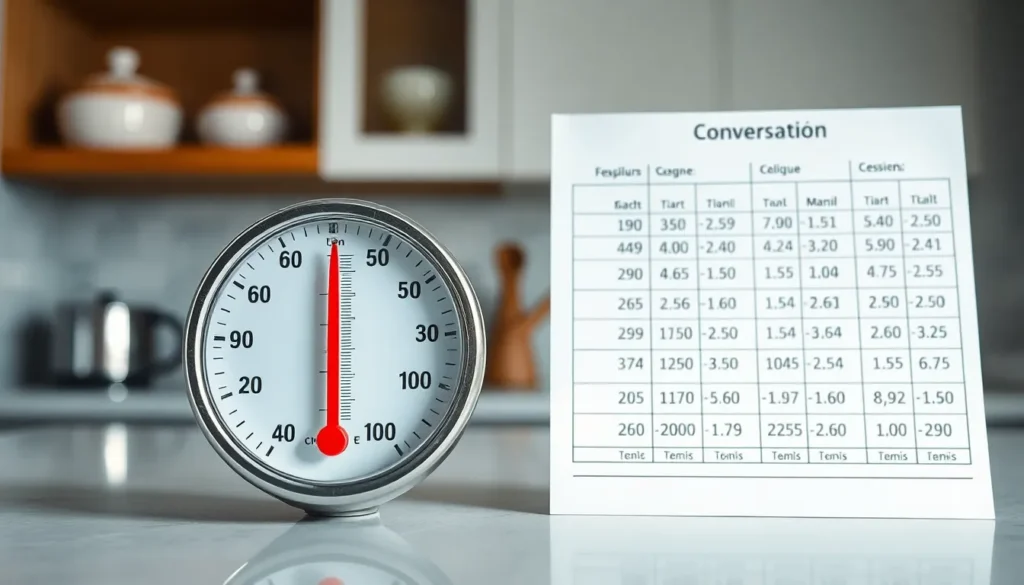
Converting 70 degrees Fahrenheit to Celsius can be essential for various applications. Here’s how it’s done.
The Conversion Formula
The formula for converting Fahrenheit to Celsius is:
[
C = frac{(F – 32) times 5}{9}
]
In this formula, C represents degrees in Celsius, while F represents degrees in Fahrenheit. Substituting the value of 70 into this formula yields accurate Celsius results.
Step-by-Step Conversion Process
- Subtract 32 from 70:
(70 – 32 = 38)
- Multiply the result by 5:
(38 times 5 = 190)
- Divide by 9:
(190 ÷ 9 approx 21.11)
This calculation shows that 70 degrees Fahrenheit converts approximately to 21.11 degrees Celsius. Understanding this conversion aids in accurate temperature interpretation in diverse fields.
Importance of Temperature Conversion
Temperature conversion plays a crucial role in various fields, enhancing clarity and precision in communication.
Everyday Applications
Temperature conversion proves vital in everyday scenarios such as cooking and travel. Chefs rely on precise temperature readings to ensure consistency in recipes and food safety. For instance, understanding that 70 degrees Fahrenheit equals approximately 21.11 degrees Celsius aids chefs in executing dishes that comply with international gastronomic standards. Travelers also benefit from temperature conversion, as understanding local weather conditions informs clothing choices and outdoor activities. Thus, knowing how to convert between Fahrenheit and Celsius simplifies these daily tasks.
Scientific Relevance
Temperature conversion holds significant importance in scientific research and reporting. Many scientific disciplines, including chemistry and physics, predominantly use the Celsius scale due to its relation to the metric system. Accurate temperature measurements influence experimental results and data analysis. For example, 70 degrees Fahrenheit, or about 21.11 degrees Celsius, serves as a common reference point in numerous studies. This uniformity allows scientists to communicate findings effectively and ensures compatibility across international research efforts, fostering collaboration and advances in knowledge.
Common Temperature Comparisons
Temperature conversions between Fahrenheit and Celsius find relevance in various fields including weather, climate, and cooking. Understanding these comparisons aids in effective communication and decision-making.
Weather and Climate
Utilizing temperature conversions serves critical functions in weather forecasting and climate research. Commonly, temperatures recorded in Fahrenheit by meteorologists can be converted to Celsius for a global audience. For example, a comfortable 70 degrees Fahrenheit translates to approximately 21.11 degrees Celsius, providing clarity in international weather reports. Meteorologists and climate scientists often emphasize these conversions to maintain consistency across diverse geographical regions, making it easier to compare climate data and analyze trends.
Cooking and Baking
In culinary practices, knowing temperature conversions is essential for successful cooking and baking. For instance, many recipes that originate in the U.S. use Fahrenheit measures, such as baking a dish at 350 degrees Fahrenheit (approximately 176.67 degrees Celsius). Accurate temperature measurements ensure that food is cooked thoroughly and safely. Chefs and home cooks alike benefit from understanding these conversions to adapt recipes from different countries and maintain the integrity of their dishes.
Understanding the conversion from Fahrenheit to Celsius is essential for effective communication in various fields. Knowing that 70 degrees Fahrenheit equals approximately 21.11 degrees Celsius simplifies interactions for travelers chefs and scientists alike. This knowledge enhances clarity in weather forecasts cooking and scientific research.
Accurate temperature readings can significantly impact daily activities and professional practices. By mastering these conversions individuals can ensure they’re prepared for different climates and culinary challenges. Embracing both temperature scales fosters a more informed and connected global community.